Coffee Novelist

I don’t write about coffee, I write about what coffee does. How it collects us, unites us and affects us.


The lost place

In order to finish the first version of the second book of my Trier series I had to start the third. There’s a lot going on in that one short sentence, not the least of which is that it sounds like the start of a word problem from high school math class.

However, I did the same when I finished the Trier. I felt like I needed to see how it “landed”. It worked for me. I discovered that I had my work cut out for me in the opening of the second novel, which I’m calling The Trier goes to London. The first challenge was making 20th century Probat commercial coffee roaster a time machine. Then, I realized that in the book, The Trier goes to London, that the trier doesn’t actually go to London. It stays in the hands of the 800-year-old Ethiopian goat herder named Kollo. But that is what will make the revisions fun.


File:Empty restaurant interior HC08164.jpg

An inconvenient booth

An inconvenient booth

One other opportunity presents itself when writing a time travel series based on the energy of coffee is that you can chose to put the next novel anywhere you like. The first two novels were set in the history of coffee.  I began reading Uker’s classic The Romance of Coffee in order to dig up to a spot for the fun to take place. There is no shortage of options since the history of coffee as we know it goes back 800 hundred years, spans the world and is filled with greed, commerce, rivalry, slavery, discovery, lies, lust, and deceit. Almost too good to be true.

I had almost too many choices. So many so that I looked into placing the next novel in the future of coffeehouses.

My space?

Except there may not be one. Our consumer centric society seems so intent on mining people’s mania for ego-separation and instant gratification (by the way, there is no such thing- sorry, I don’t make the rules), that we may no longer have very many spaces where we actually have to tolerate other people. No place will exist where we have to cooperate, assimilate or defer to each other, even for a moment. No way I drink the same coffee brewed for the guy in line in front of me, or the woman behind me. The horror! No thanks, I’ll sit in my car, on my phone, and be pulled somewhere else while doing so. Why go inside and sit near anyone, hear a bit about their lives from the booth or table nearby?
Why form even a momentary connection to someone when I can be told by Instacart that I’m too important to even think about feeding myself? Me, eat every day? I’m way too important to scratch out a grocery list.

Why are drive-thru only coffee shops suddenly popping up all over Louisville? (yahoo.com)

The future home of Scooter's Coffee at 9200 Westport Road, seen on June 27, 2023. Scooter's is rapidly expanding in Louisville.

A coffeehouse for cars


A shared space?

The growth sector in coffee these days is coming from drive up chains like Scooters, Dutch Brothers and 7-Brew. I spend a lot of time on the road for my job and can confirm this with my own eyes. At the same time, I cannot deny that my favorite coffee house is a spacious one, with enough space and tables for me to get away and read or write without having to hear people talk.  Yet, I find there is a certain energy that I like to be a part of that is generated by people in coffeehouses. It is a way to connect to the personal and universal at the same time. That is a good thing for coffee novelist, at least.

I may be a little dramatic here, but there is just not enough room for a cast of characters, fun plot twists and dashes of humor in the passenger’s seat of someone’s Chevy Gratuitous. It just does not seem to be a very good location to set a novel based on the type of community coffeehouse’s have always been known for. Or am I missing something?

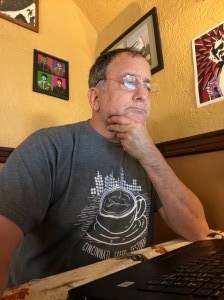
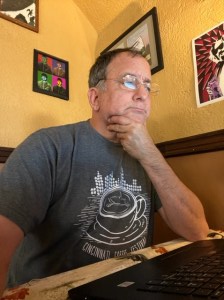
I will hopefully always be able to sit down at an inconvenient booth, open the laptop and write about a time when we had to tolerate each other, gather for a few minutes, and drink the same coffee as everyone else. Did we all enjoy that option? Not all the time, no. But I think we are rewarded more than ever these days for mistaking the easiest thing for us as being the best thing for us. Something to ponder while waiting for your next coffee to arrive via DoorDash.

I hope my coffee is still hot when it gets here.


The goal is to commit to a structure that can take on a life of its own, instead of creating only when the mood strikes. – Rick Rubin, music industry superstar.

I am a system. – James Harden, NBA superstar.


A structure


I am not sure if there are a lot of similarities shared by Rick Rubin and James Hardin, except for they both sport beards. However, this morning I am getting them acquainted just by writing this post.

You see, yesterday I finished my novel, The Trier Goes to London. I know I did because I found that I became a little emotional, my eyes getting wet with mix of sadness and joy and a lot of other emotions to boot.

This morning, I am doing the same thing, only there is no more to do on TGL. I know that is total nonsense of course. It is more accurate to say I finished TGL for the first time. A revision awaits, but I’m postponing that until it gets warmer.  I can do that in a different environment, my front porch. Plus, it will give the manuscript time to hang out with my subconscious mind and work out what needs to be done. In a month or so, I’ll be ready to access all that.

But for now, I am a structure.

I built a structure

There was not a single morning in the writing of The Trier, or of TGL that I sat around and waited for the mood to write to strike. Ah, hell no.

I am just guessing here, but I think I got up and wrote 300 mornings and maybe missed a dozen. My muse, if I had one, would have given their two weeks long ago if I asked them to put up with that schedule.

The structure is built on pillars that have nothing to do with writing as found and defined in Dreyer’s English. It is wonderful book for writers.  I found it funny enough that everyone who picked it up would enjoy it. But it would be of limited use to read without a structure around you.

Years ago, I went about building structure. It took time, trial and error and attention to detail. The pillars are captured on a chalkboard hung in my garage. I have visited these so often over the years that I do them these days out of habit. These are the pillars of the structure I built that I sit in now, that I sat in the past 300 days, and wrote another novel. I committed to them and in return, I sit contented within their walls and write, a novel, blog post, or an email or two.

I furnish my structure

The books or blogs are really just the sofa and coffee table within the structure that I built. And, I have a lot more room in here.


Shopping for a recliner.


Premium Vector | A cartoon drawing of a pair of pants with a belt that ...


Happy

Everyone now and then I think about revising my first novel, Tripio. I’m guessing that I am not alone in this, especially on one’s first novel. When I actually voiced this over a phone call to my book producer, who I worked with on the Trier, his response was that a lot of authors do feel this way. He told me what was involved from a technical standpoint in order to, as he put, “re-pour” the book into print. He also said make sure I don’t do all this work just to change happy to glad.

Happy


I have not been visited by the same urges with The Trier. In fact, as I write this post, I dare say that I never have wanted to go back into it. I may revise this post later, but I can’t think of that thought poking at me since the Trier came out last summer.

I am writing this blog post before I begin work on the follow up to The Trier, whose working title is The Trier Goes to London. It feels like I just started it.  But it is coming to an end, not by my choice, or decision or plan. It began when I had my main character sit in a chair with his back to a fireplace. It was the beginning of the arc that will conclude TGL.


Glad

It isn’t that I have had no idea what I was doing. I am a dedicated “pantser’, not a plotter, but I’m not crazy. I have had the dramatic ending of the novel in mind for months now. It has just been waiting in my subconscious mind for a chance to jump out and say “now”. That did sound a bit crazy, I guess. But then again, not a crazy as spending a small fortune to change happy to glad.


The word happy appears 31 time in Tripio.

Don’t call me that


Oscar Wilde once said that some things are too important to be taken seriously. That captures how I go about writing.  And to prove it, as I write this post I’m thinking about Monty Python’s Oscar Wilde sketch, and not any of Wilde’s plays, novels, and further wisdoms.


And don’t call me an artist. That sounds way too serious for me. No, it’s ponderous and pretentious, and is just another useless label.  My writing practice is what I take very, very seriously. The results, not so much. So, just don’t call me an artist. Here in Indianapolis, there is an annual Gathering of Artists, put on by the Indiana Writers Center, of which I am proud member. But I will never in a million years go to such a thing, unless they call it something else.


All images

I practice writing every day. I don’t even write, as such, most of the time.  In reality, I direct the neutral mental energy collected and assembled from other parts of the writing practice. Those parts include but are not limited to yoga, meditation, cardiovascular exercise, journaling, sitting in the sauna, and lots of intentional distractions such as doing the dishes, mowing the grass, feeding the cat.

It is always there

I do my best writing as I harvest the mind’s energy during all the activities I mention above. My brain and five senses are doing one thing, while my subconscious mind can act freely. It sends me names, bits of dialogue, character traits. You name it, it is always there.


So, to say I sit down, usually after a solid-ass night’s sleep, and “write” or craft or God forbid, perform the work of an artist, isn’t accurate. It just doesn’t capture how I feel emotionally about what I do to produce novels.


One of the hidden benefits to this is that I avoid labeling the results of my writing practice. Labels require maintenance and don’t work anyway because the implication of a label is that the thing labeled will stay what it is forever. Nothing does. Not the thing labeling, nor the person doing the labeling, categorizing or whatever you call it.


There is only one thing worse than being called an artist. And that is not being called an artist. Or did I get that wrong?


                           Not an artist

With the overwhelming amount of information available to us, we are more reliant than ever on categorization, labels and shortcuts- these can bring us a sense of security in shrinking the world to make it more manageable- A writer does not value safety or sameness.


A label

This quote from Rick Rubin has been visiting my mind for a while. I think it has to be because I recently sent in my application for a spot in this year’s Columbus Book Festival.

They stopped accepting applications on January 31st and so the waiting begins. I learned a lot last year when I hit the road to promote The Trier and by extension Tripio. There are a lot of venues, or landing spots as I like to call them, for a coffee novel. That is one reason I chose to move ahead with the Trier as opposed to my YA novella, Ironjaws. I worked hard on Ironjaws and had gotten as far as getting blurbs for the cover, the manuscript professional edited and all that. But I was hesitant to move on from there because I did not see a lot of ways to get the book to readers. I did not see much hope in setting up a book table at a bait shop or at a fishing tournament.


The label

The Bait ShopThe Bait Shop

The Bait Shop

The Bait Shop

But there are 38,400 coffeehouses in the USA alone. So, I reasoned I could find a few of them to set up my table. And I did. Some events were better than others, and as the novelist in residence, for at least a few hours, I was able to drink free coffee as I sold and signed (on not) my books. I love coffee, so there was not a lot to be learned there. However,  did learn that the most successful events financially involved a customer base with an intent to buy. I usually do not walk into my local coffeehouse with the hope that an unknown guy with a novel is going to ask me to spend 15 bucks. Lesson learned.

The Columbus book festival will include a population with an intent to buy. About now you are thinking, what the hell does this have to do with the Rubin Quote? Here it goes. Each book festival that I ‘ve applied for a table asks you for your books’ genre, category etc. Well, I ain’t got one. In fact, I call myself America’s Premier Coffee Novelist partially as tongue-in-cheek reference to just that. In fact, I often add the line, until I hear otherwise.  All well and good until you have fill out the application form and don’t see where you fit in.

My label

So, as I wait for the Columbus Book Fair to let me know if they want an uncategorized book vendor among the romance, thriller, sci-fi, murder mystery etc, I wonder if it is worth it? Worth it to try something new and different. Like the quote says, I do not value safety or sameness, as least as far as writing goes. I’ll just have to wait and see if the folks in Columbus do.


This is the same photo you always use.


                          The object isn’t to make art, it’s to be in that wonderful state that makes art inevitable.


Finding my voice

This morning I am reviewing my 5th Chakra. You heard me right. It is snowing and cold. I just wrote in my journal that the wind is literally rattling the windowpanes of this 112 year old house. So, why not brew some coffee and see how I’m doing in good ol’ Chakra number five?

If you don’t know how balanced or imbalanced you are in your 5th or any of your six other Chakras, I’m afraid you won’t’ be able to find out by asking Siri. Save her for ego gratification and disconnection from the effort required to actually enjoy the outcome of what you are asking her to do for you.

Chakras for Beginners: A Guide to Balancing Your Chakra Energies (For Beginners (Llewellyn's))

The Fifth Chakra is the throat, the voice Chakra which impels you to express yourself in a creative way. It can be helpful for me at least, to view the Chakras as a type of ladder with seven rungs in various states of repair or disrepair. All steps need to be working before you get to a state of detached, self-awareness in which one doesn’t have anything to defend, be the smartest guy in the room, and in which you understand that you are in the materialistic rat race world but not of it. The Fifth Chakra is the throat and voice Chakra which impels you to express yourself in a creative way.

In good voice today

I am feeling fairly sure of my footing on the 5th Chakra this morning as I write this post. I may be struggling in the 2nd or 3rd Chakras tomorrow so I’m writing this post while I’m here. It’s a new ladder every day.

A balanced 5th Chakra allows one to speak their personal truth. Of course, one doesn’t just spin the Chakra dial and end up with a balanced 5th Chakra, writing your personal truth. You have to find it first. I have had my path and it ain’t pretty nor is it recommended. It wouldn’t’ work to do what I did anyway. Your own personal truth can only be discovered by you. Makes sense to me.

I was into chakras for years and years before I read the Robert Henri quote in the Rubin book. But it was during my 5th chakra review earlier this morning that I saw the connection between a balanced 5th chakra and the “wonderful state.” The 5th chakra is knowing your tendencies and traits well enough to get out of the way and allow the liberated pure light to shine through.

Found it

Not sure where to go from here. Maybe that there is nothing new under the sun, certainly not my warped, wooden windowpanes.  Henri and Rubin aint’ breaking news here. Maybe simply feeling like I wanted to write about something I believe in (and I definitely do), like the existence of the energy centers in our bodies that the Chakras are, confirms that I am balanced in my 5th chakra, and freeing my personal truth, sharing it without any other agenda to fulfill.

Yea, that must have been the reason.


Photo taken when it was a lot warmer.

A river of material runs through us. When we share our work and ideas, we are replenished.

                                                                                                           Rick Rubin, from The Creative Act

Writing as a river

I almost didn’t start this post. I almost didn’t because I did not see where, when, or even if, it would end. Which makes sense now because a river keeps flowing, and from the shore, or sitting on a dock watching it flow by, there is no end.

My writing practice is like a river, and I could get carried away with how that makes sense to me. The above quote makes sense, perfect sense to me. But how does one share a river? A fair question. If you are brave enough to read more from this guy who thinks writing is a body of water flowing past, read on and I will provide an answer.

It is simple really. It already exists in some rivers.  You share the river by stopping the flow. Not by a dam built by beavers or named after J. Edgar Hoover. It is a temporary halt, and interruption, a redirection using the same source material, of course. It’s a waterfall.


All images


I have been integrating yoga and writing for ten years, consciously and with intent the last five or six. It has been more an intention to release everything I write during these yoga practices, even if the practice is just a five minute one before work. I have written something in the last day that I release. “Let it go, so it can flow”. And it works. I do not experience writers’ block. And since it is all one practice anyway, it is harder and harder to tell when I’m writing here at the laptop or on my mat.


Letting it flow

A couple years ago, I developed a blood clot in my right leg. I’ll leave out the grisly details as to how for now.  And I am on my feet all day at work. So, to give my lower legs and feet some respite, in the last two years, I have been finishing my longer yoga practices with in inverted shavasana against a wall. My bottom is against the wall, legs lined up along it, and my feet are the highest bit of my body. Arms at my side. My legs love the reversing flow and energy.

I am not sure why, but it may be because I’ve been writing for long enough that I needed another way to let it all go. Not just the daily stuff, but the accumulated bits the daily practice missed. But about six months ago, during my wall shavasana, I put my arms above my head, flat on the floor, spread all my fingers apart and imagined my body as a waterfall. My head is where the pool of water forms, stays for moment, and moves on.


Letting it go

I imagine this as I hold the pose, now called waterfall shavasana, and let it go so it can flow, and tomorrow I can write mo’. It works very well for me. The water flows into the pool below, stays for a bit, and keeps flowing. If I envision the writing as water, it’s how I share it.

Makes sense to me, anyway.  That concludes my sharing time for today.


 Writing practice


I spent several hours yesterday morning actually writing. Sitting on my chair at my laptop grinding away on some plot points on my follow up to The Trier. For the record the working title is The Trier goes to London. It is set in 1675, or thereabouts, because that was the year Charles II of England issued a proclamation that ordered the closing of all of London’s coffee houses. Why, you ask??


You’ll have to read the book when it comes out.


Later in the day I went to my local gym to do the editing on the work I did earlier and write more.  The writing I did on the cross trainer, on my yoga mat, in the sauna, and on my meditation, pillow will show up later today when I work again on TGL. And again, the next day, and again next week.

meditation pillow | Blauw, Meditatie, Kussen

This is my writing practice. The source line for this post from Rick Rubin’s The Creative Act, is “good habits create good art (his word, not mine)”.  My choice is writing. And I would even leave out the good. Why complicate all of this?

Or practice writing

I cannot make it to the local gym every day. If I make it twice a week, I’m having a good (not to complicate it) week. The other days, I do a five- or eight-minute yoga/meditation practice before work. I feel like this all adds up to keeping my mind in that wonderful state mentioned in the earlier post.


I’ve been doing this for years now. I know it works for me. It has to because I, like most of us, have limited time to actually sit down and write. It doesn’t pay the bills, and I have no one pounding on my front door demanding I get to work on the next novel.


So, in a few minutes when I click on to Trier goes to London, the work yesterday will look different, will tell me what to do, and give me today’s – not sure what to call it- not content, not word count- today’s opportunity to move on. Don’t like opportunity here either though.


Not to worry because I’m going to yoga class tomorrow.


I’m talking about practice.