I am out here now. It is dark, before dawn but everything is the photo above is there, expect me of course. I am enjoying my coffee and writing a bit out the front porch of my coffee home. Look at that. I have it made. I appreciate every second that I can sit there and write and drink my coffee.
That is what I was doing when my marketing materials arrived. The UPS guy pulled up in front of my coffee home and hopped out of his truck. We nodded to each other and he left put a cardboard box just about where I took this photo. I did not have to move. I knew that Tom at Coffee Homes had sent me the package a few days ago.
Coffee Homes
Coffee Homes is working with me to cross promote my upcoming novel, The Trier. I will let Coffee Homes define their work below
“Our mission at Coffee Homes is to improve the lives of coffee workers in Colombia and Honduras by addressing the pressing need for safe and decent housing. We strive to empower and uplift the coffee community through our theme of ‘Coffee People Caring About Coffee People’, by building homes that provide dignity, stability, and security for the individuals who produce the coffee we all love. We believe that by investing in the well-being of coffee workers, we can improve the overall sustainability and quality of the coffee industry, and create a brighter future for all.”
Don’t get me wrong here. I have always appreciated my home, which happens to have this porch to sit on and drink coffee and write this post. And my coffee home has a drip brewer, espresso machine, hot water, washer and dryer, sinks, stove, fridge, beds, basement, back porch, small garden in back, electricity, ceiling fans, hardwood floors, AC, and the list goes on.
But a reminder once it a while doesn’t’ hurt. That is what the UPS guy really left for me.
The list above consists of visible, material things. The real value of my coffee home, however, lies in the dignity, stability and security it has given me for well over two decades. If given a choice, you can take the material things away from me, I’m sick of cleaning and fixing them anyway.
I went to see Exhausted Paint with my son. It was a fine way to spend a Sunday afternoon. I won’t tell you what I thought of the actual play. That is more something on my end, I admit. But it is impossible for anyone else to sit in my seat, next to my second oldest son on a day when my life is going really well and see the play I was seeing. So there.
I think that you would find more value in what I did do after the play. I went home and found my 30 year old ragged ass paperback copy of Letters to Theo. A book I called in Tripio, the best book on writing I have ever read. Still true. I read about ten pages and found these excepts. Just ten pages.
Is there anything about how to paint? About how to write, even? No. But in them, you can see the paintings.
I have nature and art and poetry, and if that is not enough, what is enough?
Admire as much as you can; most people do not admire enough.
Try to walk as much as you can.
If one really loves nature, one can find beauty everywhere.
Autumn is coming fast, and that makes nature more serious and more intimate still.
Man is not easily content: now he finds things too easy and then again he is not contented enough.
Work is always a good thing.
I have been busy today with a great many little nothings, but they belong to my duty; if one had no sense of duty, who would be able to collect his thoughts at all?
Things that other care for have no attraction for me.
It is not always easy to fight against distractions, and if I had money it would be worse still.
This post received my most views ever. I just noticed that the SEO and Readability faces were not green and happy. They are now. I wonder what that means.
“We’re talking about practice.” – Allen Iverson
Allen Iverson’s quote about is best listened to. His tone is disdainful and dismissive of practice. After all, people didn’t pay to see Allen Iverson practice.
I just estimated that over the last nine years when I began to practice yoga in earnest that I have completed 2,700 practices. But when I wrote that figure in my journal, I didn’t believe it. I’m sitting here now and I am tying to work out why I doubt my own math.
Practice
I’m in the middle of my staycation week. The time found me to write that down because I am not going to work today. But if I were, I would do a five to eight minute yoga practice beforehand. The morning practice, the short one is focused more on creating energy, utilizing quicker core based asanas. I do this five days a week.
Yesterday evening, I did evening practice in my garage, my sacred space. I did my “relax and release” practice. It is a 20 minute session mainly of asanas that are held a breathe or two longer and performed with the intention of letting go of the day. I did this practice simply to help me unwind after a busy staycation day.
Sundays I will go nuts and do my self guided 40-50 minute practice, also in my garage space. I do this if I haven’t gone to the hour long yoga class at my fitness center on Saturday.
All this to say that I practice yoga daily. I do take one day off a week though. Even something as beneficial as yoga is best served when put aside.
Practice
I’m sitting here now, still in the process of not getting ready for work and I am tying to work out why I still doubt my own math. Math was never my strong suit but nine times three hundred is fairly approachable stuff.
But yoga isn’t about getting ready for the game, or any certain defined destination. And its not about adding them up your practices to see what the total is.
But It strikes me that if you did anything else that many times, you’d have something to show for it. But then my yoga practice is not something that is not performed with intention of showing it to others.
Also, yoga isn’t set up to get right, finish or complete. It is one continuous practice, broken down each day. You don’t accumulate anything along the way. It is maintenance free. If you accumulate, buy or own something, you have to maintain it. Even after 2,700 practices, yoga doesn’t require any maintenance.
That isn’t enough justification to keep practicing something that many times. I’m sure Allen Iverson practiced at least that many times on his way to the NBA. I’m not going to the NBA by practicing yoga. Heck, I’m not even going to work later.
In just a few minutes I will find my way to my mat for practice 2,701. I can’t put my finger on exactly why. I do feel I have gotten better over the years. Like I said, I am capable of guiding myself for about an hour on the mat. I recognize all the benefits post practice, both physical and mental. If anything, all the practices allow me to access those benefits in a shorter time period these days.
Practice
Even that does not lend itself to a clear jumping off point. I realize I’m using a very narrow definition of yoga here. It is the exercise flow yoga we have come to know in the west. The attempt to understand that small part of what yoga is has beaten me today.
I never will beat yoga, no matter how many times I practice. I am relieved to know that however. Not sure I want to even try.
Maybe that is all I needed to know to get me back on my mat today, where I can continue my practice. I was never any good at math anyway.
Allen Iverson played in the NBA for the 76s and was MVP in 2001
In my family of origin, I am considered the coffee guy. I was sitting in Brew Tulum experiencing a cafe Turko talking to another member of my family of origin. He was experiencing a Cafe de Olla, and in the family is considered to be the wine guy.
I once worked in the coffee industry and the other guy, my identical twin, works in the wine industry. No surprisingly , my twin and I look the same. One could say the same about coffee and wine. Both are liquids after all.
But that is where the similarity ends. Yes, my twin and I look the same. We were so hard to tell apart when we were younger that the only way that one could tell was to ask me to turn around to see the birthmark on the back of my neck. That trick, of course, was done only by folks who knew the birthmark was there in the first place. If you didn’t know, you guessed, or asked, or just gave up.
Maybe my twin and I chose career fields that are so outwardly similar, but inwardly different, in an unspoken, subconscious, twinpathic agreement to form our own unique identities. Probably not.
Anyway, the vine of the grape and tree of the coffee cherry had no choice but to be different. My twin brother and I still enjoy being twins but see more value in our differences. That day at Tulum I felt the coffee industry was trying to be more wine like. It shouldn’t. Take it from me, the confusion gets old after a while.
At the start of this post, I used the word experience instead of drink. Brew Tulum is a coffee experience to be sure. It is a warm, welcoming place and I recommend heading there when in St. Louis. Don’t get me wrong here, a coffee experience has it’s time and place. That morning with my twin at Tulum was just that, a memorable experience. Partly because I mistakenly put the sugared candy cube in the bottom of my cafe Turko. So first wave of me.
The barista sommelier server came over upon noticing my mistake. She smiled and gave me the explanation of how and when to apply the cube. My wine versed twin observed all this having started his coffee experience mistake free.
After some good natured humor at my expense, my wine experience twin noted that my coffee world had some catching up to do. Wine has been around for 8000 years, coffee merely 800.
Feeling fully superior to me now, he observed that Wine does better than coffee in spanning the space from everyday commodity to luxury product. He did not really say that. He confessed he took it from an article he had just read in a wine trade magazine.
I felt a bit clumsy, a little undercaffeinated, and ready to drink some coffee. I was not in the mood for an experience. So first wave of me, I know. But I’m always going to view coffee as more functional. It can be a great experience for lots of folks for sure, but just don’t put too much between my coffee and me.
For now, and for me, coffee is always going to be a part of something, not the point of something.
After drinking our experiences, and getting ready to leave, my twin did say that, according to the article, coffee is on it’s way to being a luxury experience. Fine for some folks but too confusing for me. Then again, maybe I just don’t like being the one being confused.
10 questions to verify your morningness chronotype
The author of this post was up before me so he thought it was a good time for a re-post.
Morningness-eveningness or chronotype is an individual difference trait1. This trait refers to the sleep-wake behavior (preferred bed times and wake times), as well as to times preferred for peak cognitive and physical performance and to psychological aspects, such as affect (e.g., the feeling after awakening). Some people are early risers that get up early, but go to bed early in contrast to people that get up late and go to bed late. Morning types (sometimes colloquially labelled as ‘larks’) usually feel refreshed soon after awakening and have their peak cognitive performance in the morning.
“We have to continually be jumping off cliffs and developing our wings on the way down.” ― Kurt Vonnegut
Do something which requires faith
I remembered this post while emailing an author acquaintance that I was going to sign the agreement to have The Trier manuscript made into a book. This process is not going to happen for free. My email actually contained the line “I’m putting my money where my mouth is.” However, I feel it more accurate to say “I’m putting my money where my mind is.”
After hitting send to the author friend, I went back to find this post. I read it just now. It made me feel even better for having taken the leap of faith I just did.
Putting my faith in a schedule outside me
For years now, I have had a day off during the week. My job has been one set up on a four day, ten hour weekly schedule. The ten hour days usually started at six or six thirty and often exceeded the scheduled ten hours. Draining physically and leaving nothing in the tank for the remains of the day, the four days could suck.
However that weekday off more than made up for it. It freed me to make appointments, clean the house, run errands, plan the calendar for the upcoming weekend and generally feel good about not going into work on a random weekday. Most importantly the day created time for me to write. To write in the morning. And I mean the ass-grabbing early mornings, often starting before five. I figured if I had to get up really early to trudge to work, then I could surely get up early to do something I really wanted to do.
I even came to understand that my physical body was not in charge. If I set the intention to write early on my day off, my mind woke me as reliably as any alarm would or could. Off I went to write. It has worked for years now, helping me write and rewrite “Back outta the World.” I wrote Tripio for the first, second and third times and launched a blog that has just recently hit 100 followers. My output was fueled by coffee and the certainty that the mornings were, as Maya Angelou said about her writing, “the only time I felt I was any good.”
Keeping the faith ain’t easy
Then comes the Pandemic. Don’t get me wrong. I feel fortunate, like somehow I had a ticket on the Pandemic Express and it blew past my stop. I kept my job, no one I know well has been hospitalized and I have kept a sense of normalcy in my overall life. Except that work changed its schedule. Not an uncommon response for these times. This meant a disruption to my daily life, and I felt, possible disaster to my writing life.
My weekday of assured, productive writing was gone. Like that. The time I knew, I knew I could write as well as I was going to write all week was gone. The reasons for knowing that time would be productive are baked into those one hundred posts I mentioned earlier. The quick and dirty message being that by the time one sits down to write it may already be too late.
Sure, I could write weekend mornings, but they have a different sort of pull to them. I have been getting up early again every morning before work but have only time to re-work Back outta the World– literally a paragraph at a time – then it’s off to the salt mines. As I write this, I have to smile to myself because this scene recalls Jay in Tripio, “bargaining with himself” for a couple more minutes of writing the same book, before he races out of his apartment to catch a bus for his shift at his Starbucks three decades ago. Whoever said, “Writing is mostly rewriting“, was not wrong.
Faith usually requires interior dialogue
“Just write in the evenings, dumb ass, you have the time these days.“
Easy for me to say. What if I suck? When I wake up, clear headed, free of the scattering five senses, I can easily access my wonderful, bountiful mind. Then and there when it is all so easily available, so effortlessly harvested. I have done this for years and know it works. Before all the rest of the day and the world find it and begin to take it from me. I know it works. I’ve seen it take shape on the screen in front of me. What if I won’t be any good in the evenings or even late afternoons?
I was left with no choice to change my tried and true method. My blogs were falling behind. Rick, T and Jay from Back outta the World were still stuck in the hills of Virginia on their way to Mexico.
I was still not quite ready to commit to any new method until one recent Sunday when I found myself on a friend’s porch on a beautiful humidity free morning. We were listening to and watching a religious service being live streamed. The message of the service was simple: that we live in a world where all the answers are at our fingertips, in our phones, laptops, podcasts and you name it. And with all that it is more difficult to do anything without knowing the answer, or most of it beforehand. The catch was that all that knowledge may not help us. It can, at times, be better for our mind, body, and soul to not know the answers beforehand.
Keep doing things that require faith
“Do something which requires faith.” This line came out of the laptop at me like I was the only one listening. Thinking back, I was. My friend had dashed inside to refill her coffee. The service was being live streamed to an empty church.
At that moment, I knew that I had to go on faith with my writing. Do something that requires faith. I will write on faith. Any writer must, really. If it doesn’t come easily, I will work on it, find a way to access my writing mind. I will work on it while holding on to the belief and faith that I can find my wonderful, bountiful, distraction free, writing mind at a time that is not of my choosing.
It worked. I wrote The Trier- The Story of a Coffeehouse- since I first posted this. It will be available on Ingram & Amazon by Memorial Day.
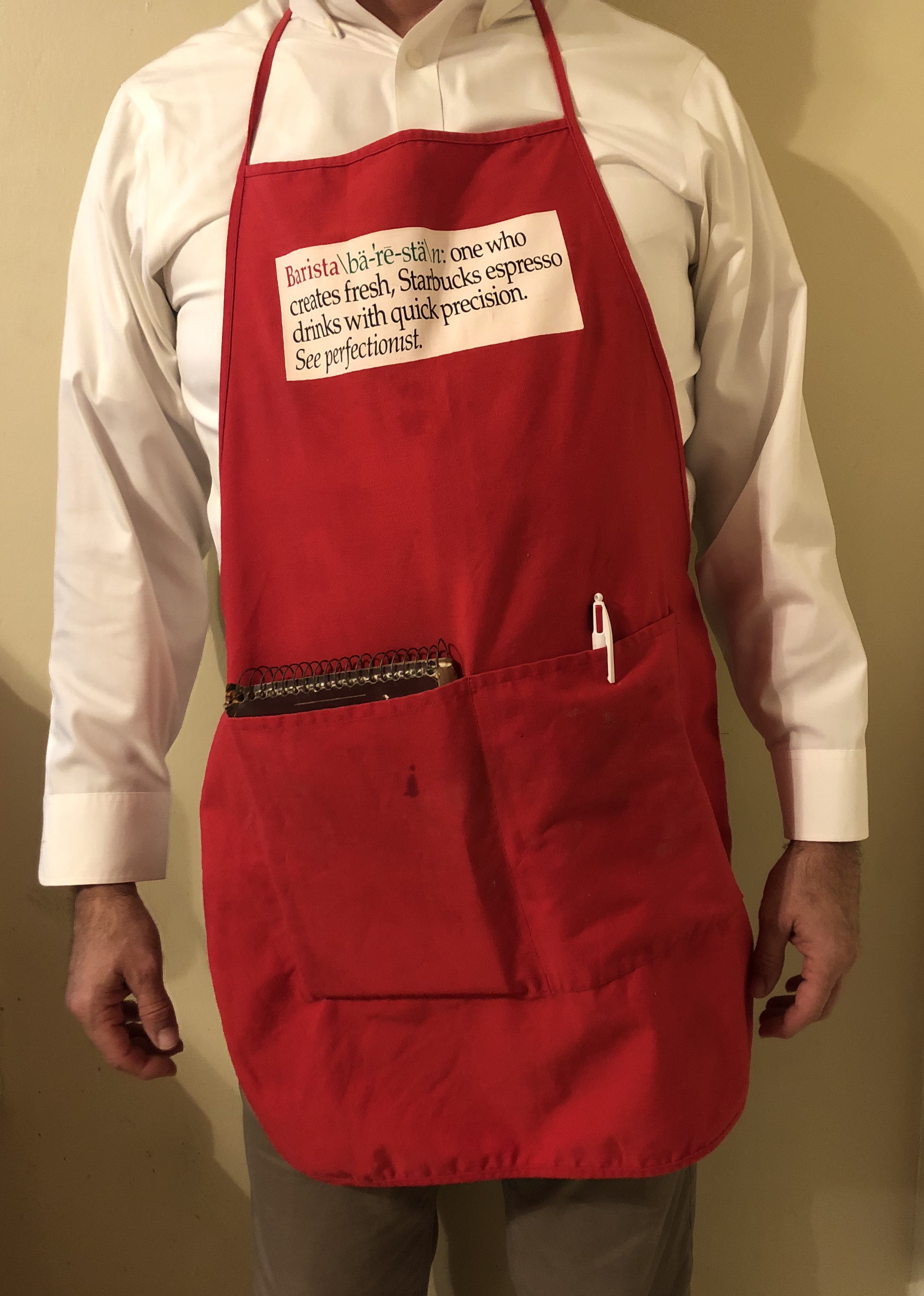
It had been over 20 years, at least a coffee wave or two, since I regularly bought whole bean coffee at coffee houses. I was spoiled by Starbucks at the start of my coffee drinking life. Yes, Starbucks was once a coffee company. They sold great varietals such as Ethiopian Sidamo, Celebes Kalossi, Costa Rica La Terrazu. I say spoiled because I received a free half pound of coffee every week just for putting on my green apron. I worked there long enough so that when I left it was hard for me to stomach paying for whole bean coffee from anywhere but a grocery store. Call me cheap. I ain’t mad.
A couple weekends ago, we are now two decades and at least two coffee waves on from my days wearing the green apron, and I just heard what my pound of Ethiopian Guji was going to cost me.
How much did that cost?
I had been in St. Louis for the weekend and had already visited the Northwest Coffee Company for to go coffee a couple times. On the way out of town I asked my ride to stop in front of Northwest so I could run in and buy some whole bean. I grabbed a bag of an Ethiopian, having fond memories of the African varietals. When I heard the price, my coffee life flashed before my eyes. The line of people behind me were not interested in watching with me. I felt like I had no choice but to leave with the coffee I had in hand. It was the reverse of a bank robbery. The car was running while I was giving the money away. I fled Northwest, jumped in the car, and we sped out of town.
I had plenty of time to think as the reverse getaway car sped over the dreary midwinter landscape of central Illinois. The initial sticker shock wore off. I considered but gave up the idea of going back to work at Starbucks just for a free weekly half pound of coffee. They don’t sell coffee anymore anyway.
After some fabulous smash burgers at the Iron Skillet gas station restaurant outside Brazil, Indiana, I felt better. Lunch hadn’t set me back, I did say I was cheap, and I began to look forward to tomorrow morning’s Guji. My mind stayed on coffee, Indiana in January is not an engrossing landscape, and I remembered what I had read about Ethiopian coffee from the book pictured above.
The hard work cost of coffee
Coffee trees are not easy to grow. The original source trees for all the world’s coffee come from the Ethiopian cloud forests, named for the altitude and shade, which are both vital for the growing of said trees.
It is a growing environment that is not easy to replicate. It is not easy to convert the fruit, the coffee cherries into our coffee beverage. This is mostly hard work. And it is hard to grow a coffee tree, hard to get the fruit to mature, and hard to pick it once it does. That is why coffee was originally consumed by popping a coffee cherry into your mouth after it had fallen to the ground.
Additionally, the growing of the fruit of the tree is just the beginning of a long, complicated series of moving parts that bring our coffee, as we drink it, to us all.
That is my review of Where the Wild Coffee Grows. And that is why I don’t review books as such. If you read this book and drink coffee, you will not bitch about the price of a bag of whole bean again. You know, like I did at the start of this post.
It was my shift. My morning at the controls of the elevated four group La Marzocco espresso machine. It was an espresso bar as theatre stage, a relic from the days before Starbucks customized and cranked out location after location. It took two steps up from behind the bar to reach the controls of the unit, which I then handled during the four hour, 800 customer rushes on Saturday mornings. However busy it was, one did feel safe up there, far from the madding crowd.
I recall one fine spring day when the entire population of Lincoln Park had decided to get a coffee from the new coffee place called Starbucks. This was 1991.The madhouse that was a Saturday morning at a pioneering Starbucks store was something to behold. This was not the time nor the place for latte art. But seriously, it seemed like the line would never end and it wore you down.
Calling out a drink incorrectly
One customer sticks with me all these years later. I remember calling out the drink as tall cocoa when I knew I had put a shot of espresso in the cup, right on top of the chocolate, swirled it, then slowly added steam milk. Then topped it with the whipped cream. It was a tall mocha.
But I called out the correct drink incorrectly. The customer would not take it even after I promised it was the correct drink, just my mistake calling it out.
I insisted. She refused.
I promised. She refused.
The doors kept opening only to let even more customers in.
I remade the drink, called it correctly, looking directly at her, and she left happy.
This encounter sticks with me all these years later because I knew I was right. The customer didn’t believe me because of what I called the cup of coffee.
The book that gave me the list below.
What I accidentally called a cup of coffee is mild compared to what the owners of taverns and alehouses of Restoration England called a cup of coffee. They were trying to stop folks from drinking this new, customer stealing drink called coffee.
Calling out coffee in the 1600’s
They came up with some great derogatory names for coffee in an attempt to stop their customers from leaving the alcohol serving establishments. The new beverage called coffee was quickly gaining popularity and the coffee houses becoming full of their former customers. Maybe not as full as my Starbucks on that Saturday morning. But too full for the tavern owners.
Below are some examples of the ways they described a cup of coffee. I found these amusing and revealing on their own when I read them. Hope you do as well.
My customer was lucky I didn’t’ make them one of these instead.
warm water boiled with burnt beans
hot hell breathe
boiled soot
made with the scent of old crusts, and shreds of shoe leather burnt and beaten to a powder
Howard Shultz and I were partners once. The Starbucks Coffee Company in my historical fiction novel Tripio was, in real life, far and away the best workplace I have experience, before or since. There have been a lot more workplaces since I hung up my apron than I care to admit. My point is, it has been a while.
I left Starbucks behind many times in the since years. My physical body left in 1994. I left it behind emotionally and editorially a second time when I finished writing Tripio. It is impossible to get the company entirely out of my system since one sees a store practically every time you leave the house.
But, I haven’t actively followed Starbuck either. Not that I need to. Family and friends send me articles about Starbucks quite often. And so that is how I came to read the NY Times article on why Howard Shultz is taking the attempts to unionize Starbucks so personally.
I referenced my novel Tripio because that time (1990-1994) is mentioned in the article in the following expert, “Mr. Schultz wrote that an employee making $20,000 per year in 1991 would have been able to cash out 1991 stock options for than $50,000 in 1996.” Not to question the Times accuracy but Howard would have never used the word employee, it would have been partners. It is how Howard always, always, always referred to folks who worked at Starbucks. It is how he referred to me when he shook my hand and gave me my Bean Stock Bravo Award.
I felt like a partner at Starbucks, not an employee.
I feel like Howard would be happy to hear that. It is want he still want to hear from everyone who works at Starbucks today. Problem is, Howard, ol pardner, it is no longer possible.
One question I leave out of Tripio that I still ask to this day is, Why didn’t Starbucks just stay a small, regional company? And a great place to work? Why does getting bigger and bigger have to be the goal? When is enough enough?
I do think Howard Schultz has the best interest of the current Starbucks partners at heart when he goes to work every day. Now there are just too many of them these days. 35 years removed from Tripio, Starbucks is a massive global entity. That must have been part of Howard’s plan. But the cost of all that is losing the partners he had in getting him there. Now, he has employees, like every other CEO out there.
We live in a world where brevity is prized. Hacks, links, flash fiction. I could think of more but I just don’t have the time. Ha. Ha. If you can say it quickly enough it doesn’t even have to make sense, like a tweet.
Seriously though, if the prize or reward doesn’t cost time or thought, its not worth having. Or it has no enduring or lasting value, so you want another one, and another and another. While that is a great set up for the folks on the other end, telling you how great it is to use, have, or experience something so easily that you barely have to think, it actually diminishes the experience as a whole.
Feel the pain
I’m taking a stand on my blog. I am calling to reverse this trend. Take the time to think, consider, review. In short (a joke) just take the time to feel the pain, inconvenience, effort of doing something because that is what makes it worthwhile, creates a lasting appreciation for what you have just experienced. Not my idea, it’s just the human condition people, so work with it.
I’m starting small in my crusade against the inanity of brevity. I have a list of words that should not be shortened. Without further ado, unless you want to take the time, feel the experience, of clicking the provided link and learn where that idiom originated, here goes:
Pod- Short for podcast. But without the cast part, there is no podcast. It’s like casting your fishing pole without the hook and line. Or bait.
Fest- An oldie but a goodie. It brings to mind infestation, and other not so pleasant events.
Appointment- Please keep using this word. It flows well, can’t really be confusing unless you call to cancel it, then you have nothing to cancel.
There you go. Short, sweet and hopefully it cost you at least a little time to read.









![Where the Wild Coffee Grows: The Untold Story of Coffee from the Cloud Forests of Ethiopia to Your Cup by [Jeff Koehler]](https://m.media-amazon.com/images/I/51Yv+TI8XDL.jpg)

![The Coffee-House: A Cultural History by [Markman Ellis]](https://m.media-amazon.com/images/I/41fmk+SO8KL.jpg)


You must be logged in to post a comment.