Coffee Novelist

I don’t write about coffee, I write about what coffee does. How it collects us, unites us and affects us.

My old partner

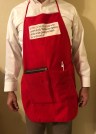
Howard Shultz and I were partners once. The Starbucks Coffee Company in my historical fiction novel Tripio was, in real life, far and away the best workplace I have experience, before or since. There have been a lot more workplaces since I hung up my apron than I care to admit. My point is, it has been a while.

I left Starbucks behind many times in the since years. My physical body left in 1994. I left it behind emotionally and editorially a second time when I finished writing Tripio. It is impossible to get the company entirely out of my system since one sees a store practically every time you leave the house.

But, I haven’t actively followed Starbuck either. Not that I need to. Family and friends send me articles about Starbucks quite often. And so that is how I came to read the NY Times article on why Howard Shultz is taking the attempts to unionize Starbucks so personally.

I referenced my novel Tripio because that time (1990-1994) is mentioned in the article in the following expert, “Mr. Schultz wrote that an employee making $20,000 per year in 1991 would have been able to cash out 1991 stock options for than $50,000 in 1996.”  Not to question the Times accuracy but Howard would have never used the word employee, it would have been partners. It is how Howard always, always, always referred to folks who worked at Starbucks. It is how he referred to me when he shook my hand and gave me my Bean Stock Bravo Award.

I felt like a partner at Starbucks, not an employee.

I feel like Howard would be happy to hear that. It is want he still want to hear from everyone who works at Starbucks today. Problem is, Howard, ol pardner, it is no longer possible.

One question I leave out of Tripio that I still ask to this day is, Why didn’t Starbucks just stay a small, regional company? And a great place to work? Why does getting bigger and bigger have to be the goal? When is enough enough?

I do think Howard Schultz has the best interest of the current Starbucks partners at heart when he goes to work every day. Now there are just too many of them these days. 35 years removed from Tripio, Starbucks is a massive global entity. That must have been part of Howard’s plan. But the cost of all that is losing the partners he had in getting him there. Now, he has employees, like every other CEO out there.

Bummer.


Take the time

We live in a world where brevity is prized. Hacks, links, flash fiction. I could think of more but I just don’t have the time. Ha. Ha. If you can say it quickly enough it doesn’t even have to make sense, like a tweet.

Seriously though, if the prize or reward doesn’t cost time or thought, its not worth having. Or it has no enduring or lasting value, so you want another one, and another and another. While that is a great set up for the folks on the other end, telling you how great it is to use, have, or experience something so easily that you barely have to think, it actually diminishes the experience as a whole.

Cartoon Ouch-pop Art Illustration Exclamation Stock Illustration -  Illustration of pain, expression: 65355095

Feel the pain

I’m taking a stand on my blog. I am calling to reverse this trend. Take the time to think, consider, review. In short (a  joke)  just take the time to feel the pain, inconvenience, effort of doing something because that is what makes it worthwhile, creates a lasting appreciation for what you have just experienced. Not my idea, it’s just the human condition people, so work with it.

I’m starting small in my crusade against the inanity of brevity. I have a list of words that should not be shortened. Without further ado, unless you want to take the time, feel the experience, of clicking the provided link and learn where that idiom originated, here goes:

Pod- Short for podcast. But without the cast part, there is no podcast. It’s like casting your fishing pole without the hook and line. Or bait.

Fest- An oldie but a goodie. It brings to mind infestation, and other not so pleasant events.

Appointment- Please keep using this word. It flows well, can’t really be confusing unless you call to cancel it, then you have nothing to cancel.

There you go. Short, sweet and hopefully it cost you at least a little time to read.

Red Apron logo

I do like blog, which is short for web log.

Don’t waste your time writing trash

Don’t waste your time writing that trash you write. Hey, I should know. I’ve written more than my share. It took four seconds to find an example from on old file. See below:

       Mid-step brooding was halted for an instant though as Altonstreet realized that Philpatrick would have already been seated, sipping his coffee significantly.


Trash clipart Vector Art Stock Images | Depositphotos

One person’s trash is NOT another person’s treasure

I’m not going there with this post. What I am saying is that it may be a way better use of your time to pick up trash rather than write it. David Sedaris does it, though in the link below, it says he does his “thinking” when he’s doing it. But, he is writing.

I know this because I have seen it work over and over and over. I consciously step away from the keyboard to allow  my subconscious mind to take over my writing. I then take my five senses and conscious, at the keyboard “writing” mind, and go do the dishes, feed the cat, grab more coffee. When I sit back down, boom, I’m writing. Or more accurately, filling in the blank page, acting as a conduit between minds, between the cluttered day to day world and the limitless subconscious mind.

It doesn’t have to be trash

I seen it work. I first saw this work on long drives. I was given the names of long forgotten baristas from a Starbucks I worked at 30 years ago. I would write early the morning of my drive and about 50 miles in, conscious mind and 5 senses engaged in the task of driving, the name I needed popped into my head. I wasn’t picking up trash, but all our minds work alike.

Since then, I “give it to my subconscious mind” instead of writing trash. Of course I’m not talking about line editing or proofreading here. It is more the realization that what you need is ALWAYS THERE. I believe that with patience, time and an intentional distraction, such a driving, taking shower, mowing the lawn, that the answers will be there.

For further evidence, I attached this list of the greatest books of all time. I can list the utilized distraction that helped make the book a great one:

Moby Dick Melville stared at waves on the Pacific Ocean for months

War and Peace  –Tolstoy watched snow fall and ice crack

Don Quixote – Cervantes rode a donkey around the arid plateau that is La Mancha

100 Years of Solitude You think that he could have written a longer book

The trash picking up in the interview below is in the latter part. But the whole interview is a great look a writer, who still has doubts about his work, even after all his success.

David Sedaris on finding a story anywhere and everywhere – 60 Minutes – CBS News


Red Apron logo

The post is part serious, part funny. I hope you can tell which is which.

Books for the Starbucks fan on your list

A while back I read How Starbucks Saved my Life by Michael Gates Gill. In the interest of full disclosure, I read it out of curiosity, as opposed to organic intellectual interest. In other words, I read it to see how that memoir compared to my historical fiction novel, Tripio. I may offer a full review in a later post. But for now, I will simply offer a comparison of “How” to Tripio, ingeniously using coffee as the yardstick.

How Starbucks Saved my Life = Blonde Roast  How Starbucks Saved My Life: A Son Of Privilege Learns To Live Like Everyone Else By Michael Gates Gill - Used (Very Good, Missing Dust Jacket) -...

Lightly roasted coffee that’s soft, mellow and flavorful. Easy drinking on its own and delicious with milk, sugar or flavored with vanilla, caramel or hazelnut.

Tripio = EspressoTripio a novel: 3 Shots: Starbucks Millionaire, Novelist, or Father? by [Jerome VanSchaik]

A complimentary blend of beans of differing origins: it is intense, deeply flavored and when brewed correctly leaves a lingering sweet aftertaste.


From Barista to Boardroom: Lessons about Life and Leadership from a Career in Coffee


I am also following up on my intention to find other books about Starbucks. I was curious to see if there were other novel length works of fiction out there with a Starbucks flavor. Ha, ha. I found the list below via Christine McHugh who is a Starbucks alum and author of the soon to be released From Barista to Boardroom. I will admit that I have yet to read any of the titles below expect the aforementioned. I have pre-ordered from Barista to Boardroom after speaking with author by phone. Both Barista and How can be and probably categorized as memoirs. Below are others worth a look that I have yet to read:


Coffee for Dummies by Major Cohen

Taking Responsibility: Heart mind and Soul by Jeff Hamill

It’s Not About the Coffee and The Magic Cup both by Howard Behar

Work Freely: Love your Job, Love your Life by Nancy Richardson

The Multiplier Effect of Inclusion by Tony Byers

Female Firebrands by Mikaela Kiner

Steady Work by Karen Guadet

Pour Your Heart into It and From the Ground Up both by Howard Schultz

Red Apron logo

This is a repost. I have since read and liked Barista to Boardroom.


Have an espresso today.

Today is National Espresso Day. I have a doppio everyday. If you don’t know what a doppio is, then its fair to say you won’t know what an espresso is. If you read the link above then you will get a good idea of what the drink is.

The most relevant point in the article for today is that espresso, in the form we celebrate today is a product of a process of brewing. The water in your home brewer or any drip format, is contacted with the grounds slowly and under no pressure. Well, there is always a little when you need that first cup. Joking aside, the water goes around the grounds on it’s way to the pot or decanter.

What is espresso ?

In creating espresso, the water is under true psi pressure and is forced through the coffee grounds. That is the difference between a cup of drip coffee and an espresso.

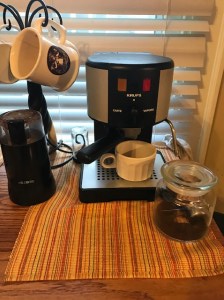
Back to my everyday doppio, which means two, or double. I have one everyone morning created on an old Krups espresso machine.

I sit with my doppio and make a few journal entries as a way of waking up the nerves and mind. In that five or ten minute span, I note the time of morning and quality of my doppio. Here are just a few entries.

  • Tuesday July 5  5:45 a.m.     Strong ass doppio.
  • Tuesday August 2 4:43 a.m.   Slightly better doppio
  • Friday September 9 6:16 a.m.   Great doppio-rich, creamy, full flavored, damn good
  • Wednesday November 2 5:30 a.m.   Fab doppio
  • Wednesday November 23 5:17 a.m.  Good ass doppio

This is an espresso. There is no drink called expresso.


Don’t try this at home. I was a barista for many years. One can’t just fall out of bed and make sweet, full bodied espresso topped with golden crema. I’m the exception.

If you look around your local coffee house you may see an Espresso Roast, or be asked do want that ground for espresso? And any bearded roast master worth his out of season knit toboggan will have his own espresso blend. Confusing?

Not to worry. Just know that today is for the drink espresso. It will be served in a small cup, which should be warm,  with a saucer. Prepared properly it will should fully flavored with a sweet finish. I would tell you what to expect to pay but have no idea since as you now know, I always make mine at home. Good luck!

Red Apron logo

The article in the link says espresso last an hour. It is best consumed moments after it is served. Why didn’t they just ask me?

Image result for cartoon chicken

I’m at the supermarket standing still and slack jawed in aisle 8. I’m staring at the shopping list that I have on a small clipboard clutched in my right hand. I started comprising this very list on Thursday night in preparation for the ritual Saturday morning shopping trip.

Thursday evening  while in front of the TV, I’ll scan the weekly flyer for items to add to this list. If there were viable, applicable coupons they were paper clipped to the list. Each day  is assigned a dinner, except Friday. No need to write in pizza. Some days, Saturday and Sunday the dinners would be drawn from a magazine recipe or cookbook. I add ingredients for those days to the lengthening list. Or, these days, take a photo of the recipe.


At one time, not so long ago, I was feeding four young adults from items on this detailed and carefully thought out grocery list. I took the responsibility of feeding them all good dinners very seriously. The list reflected that. The fact that  money was tight was baked into the choices on the list.

Image result for cartoon pancake stack

In those years, I would hear, starting about Tuesday, “Dad, can you get pop tarts, Kleenex , pretzels, eggs etc.”  The amount of possibilities was more a problem of physics than pencil and paper.  I replied, “I’ll put it on the list”. Like any manuscript, the Kroger list wwas better after some editing.

Even today, with only my mouth to feed, I prepare a shorter version of the list. I still plan dinner for every day of the week, beginning the list Thursday night and hold the list sacred to my weekly life, my world view.

With all that said, one would think that I would take the time and intention to make every item written on the list easily read  and legible. Then why the hell was I standing in the supermarket aisle 8 last Saturday morning looking for chicken fried pancakes?

I swear that is what I had written. It wasn’t. It couldn’t be. But that is what I wrote didn’t I? I wanted to go back in time and blame the kids. “Dad, could you put chicken fried pancakes on the list?”  Sure, right next to vine ripened sponges.

But that excuse was not valid anymore. It was me. This was not the first time I had been unable to read something I had written on the sacred list. I have a long history of doing it. Why? It makes no sense to be in such a hurry to scribble something down when there was no time pressing, no need to hurry. Especially when you would need to, have to, must be able to read it later.

It is just amazing what we tell ourselves. Somewhere along the line, I must had told myself I needed to get something down on the list quickly. Or that I’ll know what it means later. I could forgive myself if I needed chicken fried pancakes when the list had items for 5 people. But this  was a short list, made only for and by me.

To add to my shame I experienced in aisle 8, I have recently set an intention to write more legibly. I have a few bad habits I try to work on. Once recognized, I note them in my journal, set an intention to correct them and note my progress, if any.

This month’s goals are to write legibly, don’t overexplain yourself, and don’t look for things you’ve misplaced around the house. These are all easy ways to observe my mind in action. This post, however, is about the bad habits formed by trying to do something quickly and without intention, especially as I write . I make the same typos over and over, and over again. hte, jsut, and flet are some I almost always type too quickly. There are more. Whether it the Kroger list or a journal entry or a novel, the time spent recovering from trying to make a short cut while writing ends up, almost always, not being worth it.

I will never be able to pinpoint the time I decided it was beneficial to write a word or two so quickly that I would never be able to read it later. Of course, that is not what I was thinking at the time. I was thinking that I was in fact, saving some time. But the time passed anyway.

I have learned the hard way over the years that all thoughts are equal. One thought is not bigger than the other. The consequences that result from one thought can range from nearly meaningless to disastrous.

It was not a disaster to be temporarily blocking aisle 8 on Saturday morning. I stood there and for a fleeting moment actually hoped,  like a child who desperately wanted to believe in Santa, that I would find a box chicken fried pancake mix and vindicate myself. Not to be.
Red Apron logo

In my own defense, chicken fried pancakes might be good.

I will keep trying to work on the handwriting as well as my other bad habits. Everything takes work. So, I am about ready to head to the store now after finishing this draft. At the very least, I will check the list to see that I can read every item before I leave.

Last thing.  As I revised this post, I become curious about chicken fried pancakes. Found this if you are too.

Fried Pancakes (thestayathomechef.com)

The story of a coffee house

 Tripio opens with a prologue, which was the suggestion of my editor. He felt the book needed something to grab the reader right away. My immediate reactionary, immature and arrogant thought was that Tripio is great and that its greatness demands patience! Those thoughts did not travel from my mind to my mouth and I mumbled a more agreeable and conciliatory response to my editor.

 As it happened, just before that conversation I had been looking through my notes and old journals for the want ad I responded to for the job at Starbucks. I did not find it but knew I now wanted to use the original want ad for the prologue. 

The prologue finds Jay working at the Oregon Street Coffee house in Dayton, Ohio.  That coffee house was situated in the middle of a slowly gentrifying section of downtown Dayton called the Oregon District.  The Oregon Street Coffee house had neighbors that were becoming upscale bars and restaurants.

 It stayed opened for a while

 The neighborhood could be described as up and coming, but that could not be said for a good deal of Oregon Street’s regulars. Oregon Street opened its doors at nine in the morning. The regulars would take their stools at the bar and spend hours there sipping their coffee, smoking cigarettes, and discussing their plans for the afternoon or evening. Those regulars were indeed sitting at a bar, because the Oregon Street coffee house was a real bar for many years before becoming a coffee house.

But in Jay’s time the drink they served there was warm and brown coffee supplied by Dayton’s one and only coffee roaster. The regulars and the history of the place were only a couple factors contributing to the character and unique vibe Jay found while employed at the Oregon Street coffee house.  The coffee was not what Jay liked however. Later in Tripio Jay admits that “the Cosmodemonic does the coffee right’, after he tries a cup of coffee at a coffee house in Chicago that reminds him of Oregon Street’s brew.

Stayed opened

     The visits Jay takes to his “coffee house under the tracks” show that Jay is homesick for his artsy coffee house in Dayton. At the same time, he acknowledges that his new employer has better coffee. Tripio is set in 1992 but Jay’s choice in where he finds his coffee fix has been repeated millions and millions of times by millions and millions of people. In the novel, Jay is simply going about his life making day to day decisions.

He wasn’t choosing sides in any debate over whether his employer was responsible for the closing of coffee house like Oregon Street. That is the subject for books to come. Jay is about to face life changing circumstances which will make him decide bigger things than where to get his coffee: his employer is growing and is offering opportunities, he is trying to sell his first novel and his new lover is expecting a baby.

It closed a long time ago

By the way, if you are ever in Dayton, don’t bother looking for the Oregon Street Coffee House, it closed a long time ago.

But is open again in my novel in progress

This is repost from back a couple years.  Maybe this post was the first step in placing my next coffee novel in a coffee house called the Trier, clearly based on my time at the Oregon Street Coffee house. Stay plugged in for more on The Trier.

Red Apron logo

Happy International Coffee Day 2022


     “Who would read a novel Starbucks novel?” I asked the facilitator of my “Author Development” class. Her answer would be important to me. After all, I had just written one. She looked my way and made eye contact for a moment. She then looked out above my head towards the wall behind me in order to give herself a second to think.

   Up until then, I have been getting a bunch of good info and intel in this class. Just to clarify a bit, this wasn’t a class on developing oneself as an actual writer. This class was directed towards creating a brand and finding an audience for one’s work. The facilitator, Darice of  www.thepowercollective.net has been successful in building her own brand and business based upon a book she released some years ago. Granted, her title was non-fiction and Tripio is a work of fiction, set at a Starbucks in Chicago in the summer of 1992. However, the book market globally is worth $145 billion dollars. I took this three class course with that in mind, hoping I could get something from her wisdom. And maybe even some of that global book market money.


I discovered during the first two classes that there are a lot of people out there who want to help get your book published. A quick click or two reveals zillions of podcasts, books on selling books, websites, seminars,  and blogs offering a dizzying variety of solutions on how to get your book placed in the right genre, at the right time, in the right place at the right price with the right cover.

Alas, I wrote Tripio with none of that in mind. I was also discovering that it would have been wiser to find a genre, a category, a searchable title, a clickable cover, a bannered headline for that cover and lots more before taking a book to market. My bad. It was even best to do all this before even writing said book. Double my bad. I felt like I had a lot of catching up to do.


COFFEE DRINKERS WOULD

    Fortunately for me, Darice had spent considerable time and trouble navigating this 145 billion dollar ocean so I was all ears awaiting her response to my question. She returned her gaze from the wall to look me in the eyes to answer “Coffee drinkers.”

    Eureka!  Starbucks is a coffee company isn’t it?  I had forgotten that even in my own book, the protagonist, Jay, responds to the want ad from Starbucks because.” About the only real qualification I have is that I’m a coffee lover.” Over the duration of these three weeks, I was beginning to feel that it would have been easier to write the novel everyone else was telling me I should be writing. I had the sinking feeling that I had written a book to write it, not to sell it. Triple, or better yet, Tripio- my bad. Darice’s response was a lifeline thrown to me, treading water in a vast ocean of advice, websites and SEO. I straightened my spine. A smile emerged on my face. The sack of goo left my gut and replied, ‘Thanks!”

  In Tripio Jay does get the job at Starbucks partly because he loves coffee. I started Tripio partly because I love to write. Something worth reading must have come out of that combination, right?

As I mentioned earlier, this was not a class on developing oneself as a writer. Darice knew her brand building. I did get lots out of the classes. I did things backward but I took that to be good news. Because I have since come to believe that once a writer starts chasing all this wonderful advice and data, before sitting down to write their novel, that it is too easy to lost on the $145 Billion dollar ocean. Darice’s answer was the life jacket I had been looking for even if I hadn’t know I was asking for it.


Red Apron logo

This link may help you find a free cup of coffee today-https://www.today.com/food/free-coffee-national-coffee-day-2023-t264448


“Those who manage to be where their coffee is will grow, stretch and emerge stronger, smarter and more prepared as we find peace and gratitude in the pause after the sip”

This expert is from the above book and has been modified by me.

This morning, I am where my coffee is

I am thinking, between sips, about “what be where your feet are” means to me. It took a minute or two and more than two sips of coffee. Then it struck me. It means to me that we should live each and every moment with thoughtful intention, taking that moment for what it is while accepting that the time is going to pass anyway. I find it easy to do this on my front porch, on my laptop, so early in the morning that it is still dark and the crickets and gentle drops of rain are the only sounds. In the interest of transparency, I am in fact on my second up of coffee.” God help me, I do love it so’ George C. Scott as Patton.


But he was talking about war, I am referring to coffee. The energized calm it brings to my mind is, to me, priceless. It engenders a confidence in my being and by extension my writing. The rituals I cultivate and maintain based on when and where I have my coffee are sacred pillars of my daily routine. My hierarchy of values would crumble without coffee. Bring all of life’s distractions and troubles to me here and now. I got this.

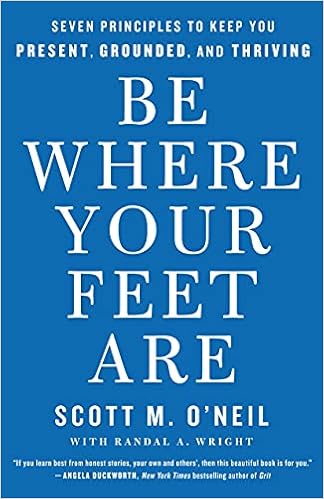
Well, since life doesn’t work that way, we have to prepare to take part in it without getting overwhelmed, frustrated, depressed, anxious. I took and modified the above expert from the book, Be Where Your Feet Are by Scott M O’Neil. I haven’t read it, but if I plug it on my blog then I feel I bit better about altering the except. It’s National Coffee Day, 2021 today so I feel like it’s appropriate. Plus, we will all take something unique from the book, when reading it. So, why wait? I am already feeling confident, as I said. Therefore I am going to cheat and give you my takeaway with the coffee angle.

Leaving my coffee behind?


Be where your coffee is and you will not longer waste time looking for things you have lost. Sound too good to be true? Well, it’s not. I’ve have had lots of practice. What this modified wisdom means is that if we remain intentional with every thought, every moment, every cup of coffee we will never lose or misplace things of value to us. Impossible you say? Hell yes it is. Because, we cant’s stay on our pre-dawn porches sipping coffee an listening to it drizzle for the rest of our lives. But when we lose something, like a ball cap or pair of glasses, we can mentally remain or return there. We can return to the mentally calm yet energized place and wait for the glasses or ball cap to come back to us. Believe me, they will. I know because for me they just did. But I knew they would- and that is the secret. Intrinsic and internally generated thoughts are what are best observed and obeyed.  Nothing is external. Or, more accurately, I’ll modify that also to nothing of  truly gives us return on its value is external.

The losing of

On the very same day about three weeks ago, I realized I had “lost” my fourth pair of glasses and my Ohio State Buckeyes baseball hat. These items are useful to me. I have four spots in and around my house where I need and keep my glasses. The ball hat I use to keep the sun out of my eyes when I drive. I discovered that both were gone as I went about my Saturday machinations.  For most of my adult life, I thought anger, frustration and withering self-criticism were the answers here. Losing something meant getting pissed and wasting a lot of time looking of it. Not any longer. I have spent the last several years practicing the understanding that misplacing something is an act of a distracted, unintentional mind.

Therefore, the resulting action is to not to look for the glasses or cap. But to to wait for them to come back to you when you need them to. That is, after you have relearned the lesson that in that moment when you misplaced them your mind was distracted by the external. It was was not in nor on that moment. Your mind was not on sitting calmly on your porch taking in the calm pre-dawn drizzle. Your mind, meaning you, was NOT where your coffee was.

The finding of

Last Saturday I was in Bloomington, IN taking a few things to my son who attends IU. I was taking a few thing out of the hatchback of my car. There was my Buckeye hat. The following day, I was at my writing table in the living room. I got up to heed the call of nature and when I returned to said table there seemed to be one more pair of glasses there than before. I stood at the table for a moment as I counted the pairs of glasses on the table among the books and old journals. Two. I looked on my spot in the house where I pay my bills and the usual pair was there. Lastly, I stepped quickly to this spot on the porch and saw pair number four. How the hell?

Always try to be where your coffee is

Both the hat and the glasses had found me. I had not wasted time looking for them. I had understood that I had been distracted and living a moment without intention when I misplaced them. That is the real value here, not the found external objects. Useful? Yes? Replaceable? Yes. The time I would have spent looking for them replaceable? Hell no! My feet were not where my coffee was. This is not the first example of me waiting for something I had lost to return to me, just the latest. We can not always be sitting calmly in the predawn drizzle with a nice Saturday  morning cup of coffee in our hands. But with a lot of practice, intention and internal focus we can keep that mind moment with us, not to mention our glasses and favorite ball cap. Next time you misplace something, take a breath, find your mental coffee cup and do NOT look for it. It will be there ready and waiting-when you are.

Red Apron logo

Kurt Vonnegut’s quote will warm the mind and body.

A few days ago I visited the Kurt Vonnegut Museum in my hometown of Indianapolis. I am not from here, Kurt Vonnegut was.  I had never been there as close as I now live to it. And it required out of town visitors interested in seeing the museum to get me there.

A few weeks ago I published a post that I called ” Writing without a hook

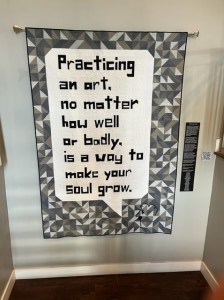
The quote on the quilt from Kurt Vonnegut expresses briefly, clearly and beautifully what I tried to say in my less brief, clear and beautiful post. Hey, I ain’t apologizing. No one’s going to my museum. But here’s the quote on the quilt in case you can’t make it to the museum.