Thanks for checking in this year. Just been hibernating in the real world and been enjoying the break from all this filtered reality. But I plan on seeing you all next year! Have a great Holiday Season! Thanks, Jerry


Thanks for checking in this year. Just been hibernating in the real world and been enjoying the break from all this filtered reality. But I plan on seeing you all next year! Have a great Holiday Season! Thanks, Jerry

It is not an edit, a fix, a mistake. It is an opportunity. A chance to make something better. Who is this world hasn’t benefitted from a second chance in some way or another? I know I have. In fact, I can think of many times when I’ve been given many more chances than I may have deserved. If viewed in a positive light, a mistake is simply an opportunity to learn something.
Editing your own work is a must, but who wants to do that? It is like going out to your garden the day after you pulled weeds and planting them all over again. It must be done, but it ain’t fun. There is a great tempation to send the piece off to an editor you trust, if you are lucky enough to have one, and tell them you’ve done all you can do, now its your problem. Or words to that effect. Problem is, that person charges by the word.
So, it is a great practice to befriend editing your own novel, poem, essay, or work of choice. We all must do what works for us. I have come to trust in the passing of time. If you can’t beat it, join it.
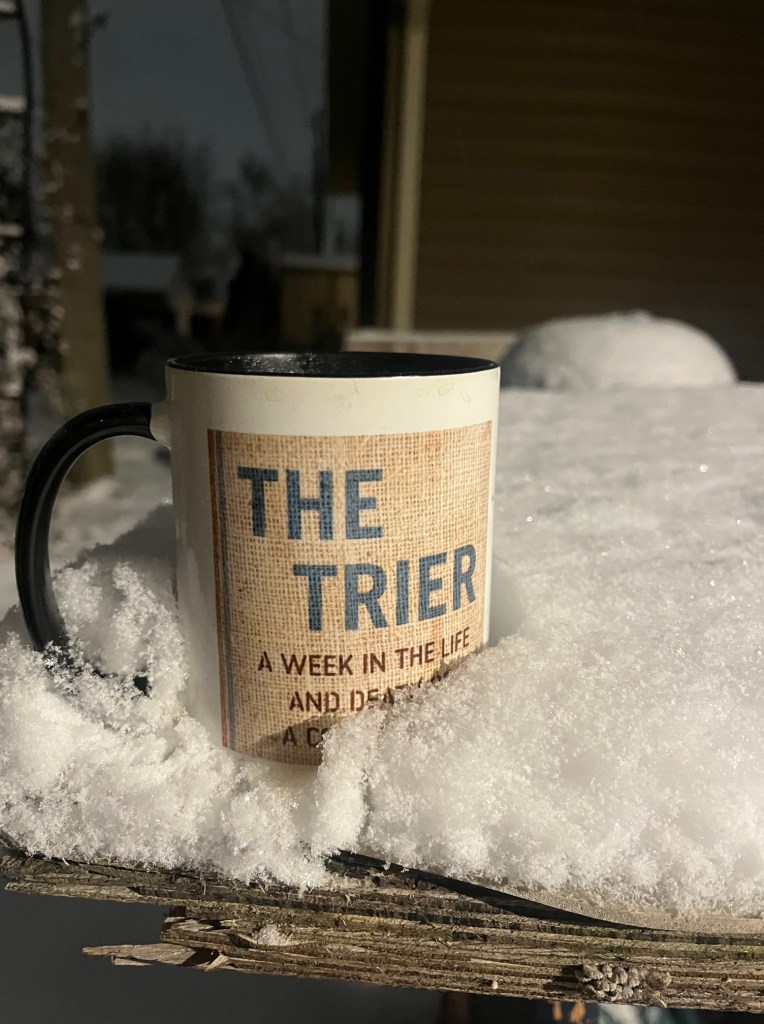
This practice developed over the course of writing the two or three novels that came before The Trier Goes to London. The trust in that process grew over time as well. So much so that I planned on time-editing TGL over the summer to return to it in October. And I have.

And, it has worked for me. The passing of time gives me the distance to see my own writing more objectively, more clearly. Then the decison to move, change, delete and rearrange my own amazing words is just a business decison and not an emotional one.
But I do have to two rules to follow. You heard me. Just two. It’s not that I ignore all the others but the two that guide my hand are:
So, here are just a couple examples of opportunities I’ve let father time reveal to me as I revise The Trier Goes to London. Have a look.
Original 1
“A great many wagons are gone through this place with ammunition for the Saxon army.”
“No use. I can read it.” Philpatrick said.
“Not that. This.” The Widow Giles had emerged from her nook holding the Proclamation out in front of her. She took a step towards Philpatrick.
Father time edit suggestion
“A great many wagons are gone through this place with ammunition for the Saxon army.”
“No use. I can read it.” Philpatrick said.
“Not that,” The Widow Giles had emerged from her nook holding the Proclamation out in front of her. “This.” She took a step towards Philpatrick.
I feel like there is more heat generated by moving “this”
Original 2
“What you selling mate? Your bottom?” The questioner had stepped out of the Blackened Bean to find Altonstreet and Philpatrick blocking his way. ‘How much then?”
‘Uh, no. He wants to see the.. the magic…no… the pouch in my back pocket,’ Altonstreet said.
“He wants to see it first then?” The customer looked at Philpatrick. “Buyer beware, eh?”
Father time edit suggestion 2
“What you selling, mate?” The questioner had stepped out of the Blackened Bean to find Altonstreet and Philpatrick blocking his way. He faced them empty-handed, a few days of growth on his chin, a smile on his lips and caffeine blossoms on his cheeks.
“Selling?’ Altonstreet asked more to acknowledge that he understood. He understood the language, the fact that it was a question, and that he and Philpatrick would be able to communicate here in London in sixteen seventy-five, or thereabouts, without much difficulty.
“Your bottom?” The questioner had stepped out of the Blackened Bean to find Altonstreet and Philpatrick blocking his way. He must have enjoyed his time in the Blackened Bean as he seemed to not be too irritated that the two strangers were directly in his path. “How much, then?” He asked, keeping the smile in place.
‘Uh, no. He wants to see the.. the magic…no… the pouch in my back pocket,’ Altonstreet said.
“He wants to see it first then?” The man with the caffeine blossoms looked at Philpatrick. “Buyer beware, eh?”
Felt like I took the easy way out by just describing the plot-expediting character as “questioner”.

It is the summer of 1992. In my “Starbucks novel”, Tripio, Jay works at a Starbucks store #204 located on north side of Chicago on the corner of Clark, Diversey and Broadway. In Tripio, for the sake of brevity and authenticity, I refer to it simply as store #204, or even just #204. Tripio is a historical fiction novel, set at time when there were around 100 Starbucks locations up and running. However, store #204 was already showing sings of decay from 1,000 transaction Saturday mornings when Jay arrives there as the new Lead Clerk. Jay is an aspiring novelist and so he liked the store’s physical character and the stories it told. His co-workers were mostly aspiring to make a living at one art form or another, so Jay felt he fit right in.
There are several passages in the book when Jay writes that he feels at home at #204. He finds comfort settling back in there for a shift after returning to the city from a trip downstate: “ I had spent too much time here not to treat #204 as a home away from home.” Looking back, that was no accident. The decision Howard Schultz made to empower employee partners with health insurance and stock options was vital to it’s growth and success. In effect, that decision put owners in every Starbucks.
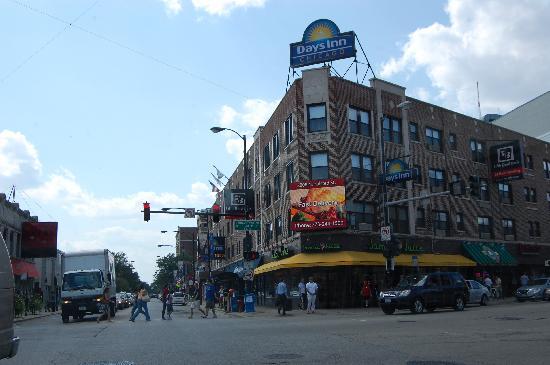
I had a strong desire to physically take a trip back to Starbucks store #204 as I was writing Tripio to confirm the details that had gone into the book. I also wanted to look again on the Days Inn that stood diagonally and across the street from #204. There were many, many nights I closed #204 and had to get back to open or at the very least be back for a morning shift. If I closed, I locked that door after midnight. If I opened the next morning, it was at 5:30 or 6 a.m.
The Days Inn stood just across the street on those nights, calling me, tempting me. A shower and bed was just minutes away. My apartment was a long bus ride up Clark. It could take almost an hour before a shower and bed there. I would then have to make the return trip on almost no sleep. A night at the Days Inn would remedy all of this. But no money, no way. So, I made do with my tripio over ice.
Then, the summer 2017 arrived I took the opportunity to drive to Chicago and see both places. I had finished Tripio. I wanted to confirm the details of #204. It had been 20 plus years. My trip back to Starbucks store #204 was also a gift for my daughter. She was headed to college in the fall and we went together as a going away present. That is why I did no research on whether #204 still existed. I was going anyway.
Not surprisingly #204 was no more. If it is true that you can’t go home again, at least you have a shot if it still standing. A new collection of newer storefronts had taken over the whole building that housed and surrounded #204. I can’t say I was actually surprised. However, Store #204 was still very, very much there for me: I could still hear the thud of the filter basket hitting the bar across the dump bucket positioned on either end of the espresso bar, the grinders clicking on and the shriek of the hot steaming wand entering the cold milk. I pictured where I stood to expedite the lines during the 1,000 transaction mornings. I thought that I could even catch the scent of a massive urn of Sumatra Mandheling brewing as the morning crew went about the opening process.
Not having a physical confirmation of #204 may have made me work harder to recreate #204 in Tripio. I had to work to rebuild it, and I did. Look for proof when you read Tripio in the scene where Jay dusts off an “order here” sign that hung unnoticed by almost every customer and most partners who had ever entered #204.
So, my trip back to Starbucks store #204 was a success even if it physically was no more. I had confirmed my memories. But the best part was that I finally got to stay at the Days Inn. It is now called The Versey. Yes, the bed and shower sure felt great after all those years of waiting to get there.


I can imagine having coffee without writing. I cannot imagine writing without coffee in me or at least nearby. In the evenings, I often sit with a mug nearby with no intention of drinking it. It helps me write just to have it nearby.
I came across this list of quotes by ten coffee loving authors the other evening as I was not drinking my coffee. It struck me that I have lot in common with them, especially the bits about being a coffee lover and a great writer.
To confirm the latter, I imagined all those below as if I were a barista and they were my regulars. My reviews of them as coffee drinkers, not writers, is below their own quotes on coffee. Hope you like them.
‘Were it not for coffee one could not write, which is to say one could not live.’ Balzac used to drink 50 cups of coffee a day. He woke at 1 am each day and wrote for seven hours. At 8 am he napped for 90 minutes, then wrote again from 9:30 to 4 pm. He said: ‘As soon as coffee is in your stomach, there is a general commotion. Ideas begin to move…similes arise, the paper is covered. Coffee is your ally and writing ceases to be a struggle.’
As a barista – Always asks for “ just a warm up” in his cup so we can’t charge him for refills.
Kierkegaard had an interesting coffee ritual. He poured sugar into a coffee cup until it was piled up above the rim. Next came the incredibly strong, black coffee, which slowly dissolved the white pyramid. Then he gulped the whole thing down in one go. He wrote: ‘At any rate, I prize coffee.’
As a barista – When I see him in line I always look to see if the sugar dispenser on the condiment stand is full.
Voltaire was said to have drunk 30 – 40 cups of coffee (mixed with chocolate) every day. Although he lived to 83, his doctor warned him that his beloved coffee would kill him. He was a regular at the famous cafe Le Procope in Paris and you can still find his desk displayed there.
As a barista – He always orders his mocha made with extra chocolate, but with skim milk.
Stein also loved coffee. She wrote: ‘Coffee gives you time to think. It’s a lot more than just a drink; it’s something happening. Not as in hip, but like an event, a place to be, but not like a location, but like somewhere within yourself. It gives you time, but not actual hours or minutes, but a chance to be, like be yourself, and have a second cup.’
As a barista – One of those clueless people who has no idea we were closing, even when I started putting up the rest of the chairs and turning off the lights.
Franklin had high standards for his coffee. He said: ’Among the numerous luxuries of the table…coffee may be considered as one of the most valuable. It excites cheerfulness without intoxication; and the pleasing flow of spirits which it occasions…is never followed by sadness, languor or debility.’
As a barista- A bit of a prick, but leaves good tips.
Pope enjoyed coffee. He said: ‘Coffee, which makes the politician wise, and see through all things with his half-shut eyes.’
As a barista- Tried this line on just about every female barista we have.
Rousseau said: ’Ah, that is a perfume in which I delight; when they roast coffee near my house, I hasten to open the door to take in all the aroma.
As a barista- He actually lives near the bakery.
Barry wrote: ‘It is inhumane, in my opinion, to force people who have a genuine medical need for coffee to wait in line behind people who apparently view it as some kind of recreational activity.’
As a barista- The worst. He expected us to start his drink as soon as he stepped in, even if there were twenty people in front of him.
Goethe was an enthusiastic coffee drinker. Goethe was interested in decaffeinated coffee to reduce his insomnia. His friend, Friedlieb Ferdinand Runge, was able to isolate relatively pure caffeine from coffee beans in 1820.
As a barista- A pain. Always asks why we didn’t brew more Swiss Water Process decafs.
Swift needed coffee at least once a week to write. He said: ‘The best Maxim I know in this life is, to drink your Coffee when you can, and when you cannot, to be easy without it. While you continue to be splenetic, count upon it I will always preach. Thus much I sympathize with you that I am not cheerful enough to write, for I believe Coffee once a week is necessary to that.’
As a barista- Nice enough guy but always wants to talk when there were ten people in line behind him.

There’s free coffee near you today

In Tripio, Jay’s prehistoric coffee landscape does share much with the one in which the modern barista roams. Tripio is three plots and narratives alongside and intertwined with each other. The Starbucks growth narrative is told from a barista’s perspective. Jay starts out as a barista. And even when promoted up the chain to store manager, Jay remains a barista at heart. After being promoted Jay still takes pride in his performance on the espresso bar at his current store. He realizes that he must display mastery of the espresso bar for the customers and store functionality.
This was the time, I call it the land before Starbucks, when Jay (me) cared about how you drank your coffee. Yet, it was not even the first time, nor the last time I cared about how you drink your drip coffee, latte or mocha. I cared about how you took your coffee when I worked at The Oregon Street Coffee House, Boston Stoker, Brazilia Coffee, Starbucks, Barnes and Noble Cafe, Aramark Refreshment Services, Filterfresh Coffee, Hubbard and Cravens Coffee, Julian Coffee Roasters and Harvest Coffee Roasters.
In any case, all my coffee extensive and varied coffee experience came before I came to know blogging. In that way consider myself a dinosaur. Yet I also consider myself a heritage barista. A spiritual great uncle to thousands of baristas come and gone since the start of the first Bush presidency. And much like the singing dinosaurs, I once knew, I did go extinct. Unlike them, however, it was partially it was by choice.
I can very honestly say, I do not care how you take your coffee. You see, I’ve been there and done that for real. I once had to care about how you took your coffee because it earned me the money I had to make in order to keep food on the table, to feed my dino-loving sons. I HAD to know, memorize and prepare your coffee drinks to keep my income coming and my life going. Then, I truly cared about how you took your coffee.
The flip side is that I don’t care about how you take your coffee now. So, I am not going to use coffee as click bait. This means that I care about you as readers and followers of this blog too much all to tell you I do care. I won’t pretend I want to know, now, just to get a couple cheap clicks. That honesty and work ethic kept me working in coffee for all those companies for about 25 years total. I will apply those traits to my career in blogging, no matter the duration.
Stepping off my high eohippus, I admit that I actually enjoy responding to click bait once in a while. Just don’t expect it from me here. I am reasonably sure that dinosaurs didn’t sing. And this coffee dinosaur doesn’t have to pretend like he can.

This is a repost for National Coffee Day 2025 –

To submit a query, please use the form below. Please fill out all fields. If an agent wishes to read your submission, he or she will contact you in response to your query, usually within 6-8 weeks.
Which agent would like to submit to?
https://www.fineprintart.com/art/history-of-the-starbucks-logo
There she is. My agent. She and I actually worked together in the early 1990’s so it may not seem entirely fair for me to call on our old relationship to help me get Tripio published. But, when I asked her directly she didn’t say no. Nor did she send a rejection email. I didn’t even have to tell her “Why I chose her to submit to”. No need for a publication history. No need to create a query letter. And since we already knew each other, I didn’t even have to submit a bio.
I first thought of looking up her old contact information again when I was close to halfway through the “memoir” version of Tripio. I was beginning to realize that the piece I started was going to be a novel. I was noticing that if I had told anyone what I was writing then, I said I was working on a “Starbucks novel.’ I tried not to look ahead but as the writing continued I knew that the “Starbucks Novel” was how I would have to sell the book. No one would care about an unknown writer who had just finished a novel. Boring. But, someone out there, reading my query with a Starbucks in his or her hand, may just be intrigued by Tripio.
When the time came, I did find her old contact information. I was told by her gatekeeper that she was closed to queries for at least six months. In a rare show of self-belief and conviction I insisted on at least leaving a message. I told the gatekeeper that I would be remembered because when the two of us worked together at Starbucks there were only 450 employees and it felt like everyone knew each other.
Wouldn’t you know it, she called me back the next day. I didn’t have to wait 6-8 weeks. We hit it off again just like old times. I told her I was a lot older now but felt great. And she replied that she has gotten a little less willing “to show some skin” like she did when I first met her. I asked about the old guard. She said she doesn’t see much of them anymore but she was sure they’d love to read Tripio. It was her idea that I send blurb requests to Howard Behar and Kevin Knox. And she was right, they have both said yes.
We caught up for a few more minutes but she had to go. A lot of Starbucks are still opening around the world and she couldn’t talk too long. She also said that Howard Schultz was writing his own book and wished me luck on mine. I hung up, regretting that I had not given her my contact information so we could stay in touch.


I know that I was poking fun at brevity in a recent post, but here I go. I’ve been reading way too much on the history of coffee, so this was just a way of letting of some mind steam.

Wow. I found this in my drafts folder. I thought I had posted more about Marcus Aurelius’s Meditations. I guess not.
It strikes me that since I read Meditations that Ai has been creeping more and more into our lives and even our minds. In the year or so that I read Meditations, Ai has become part of our everyday lives. Nothing has changed in humans since the times of Aurelius. The mind and the power of a single thought remain the origin for all the best things we have done. And the worst of course, but then you can’t have one without the other. Meditations is a warning, to me at least, that giving even one original, unique thought away to an external source is at best a waste, and at worst, terrifying. As for me, I hope we never give up our ability to use our own minds in exchange for the slight of hand of convenience and someone’s else’s financial gain.

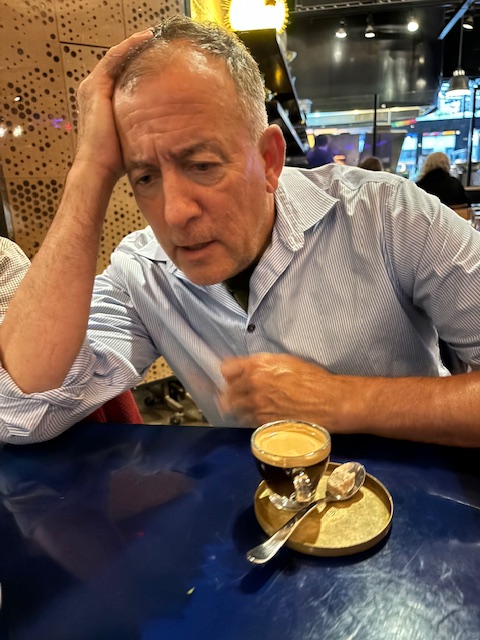
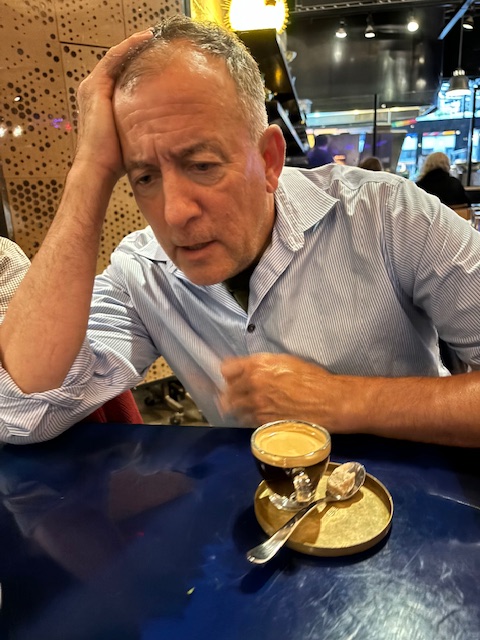
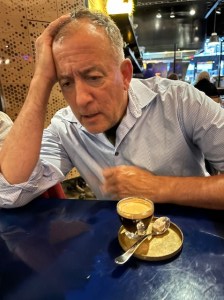
No, I didn’t generate this image with Ai. I would have more hair if I did.
I hope you enjoyed the popcorn and used the restroom during the intermission. I have continued to grind away. Before I move on, I must clarify my grind type. As you may be aware, not all grinds are the same. I have a drip coffee maker, an espresso machine, and a French Press maker. Each performs best with a different grind. The espresso is very fine, the French Press is coarse, and the drip in the middle.
My grind is set to authorpreneur, or direct to reader author, or independent author. Take your pick. My grind is not set to submitting manuscripts to the Big Five, or traditional publishing houses. However, as you will see below, I have spent some time using that grind. Sick of the coffee metaphors? Me too.


Well, I paused and leaned into the question, “You have to grind away until you find a way.” That will be my response one of these days when I’m asked how I become a global literary superstar. Until then, I will rerun the pretend interview in my head.
What is not pretend is that everything is work in the end. With my writing practice on intentional hold for now, I’ve found myself noticing how much work you do when you are not writing, especially if you’re intent on selling a few books. They ain’t gonna sell themselves. I need to look no further than my own three title to prove that out.
But back to the grind. I like to sit on my front porch with my laptop and put in my hour of writing adjacent work. But the mosquitoes, heat, and tenuous internet connection have been driving me inside to my cooler, connected, and mosquito-free desk. Here, I have been grinding away at all the stuff that comes with being a authorpreneur. If you are of the same mold, you may recognize some the items on the list any may find some value in my experiences. If you are reading out of pure intellectual curiosity- Do people even do that anymore?- then all the grinding noise may come as a surprise. Hey, its all work in the end.
Intermission Time. This post just turned into a double feature. Go for some popcorn and I’ll work on the next one.

You must be logged in to post a comment.